

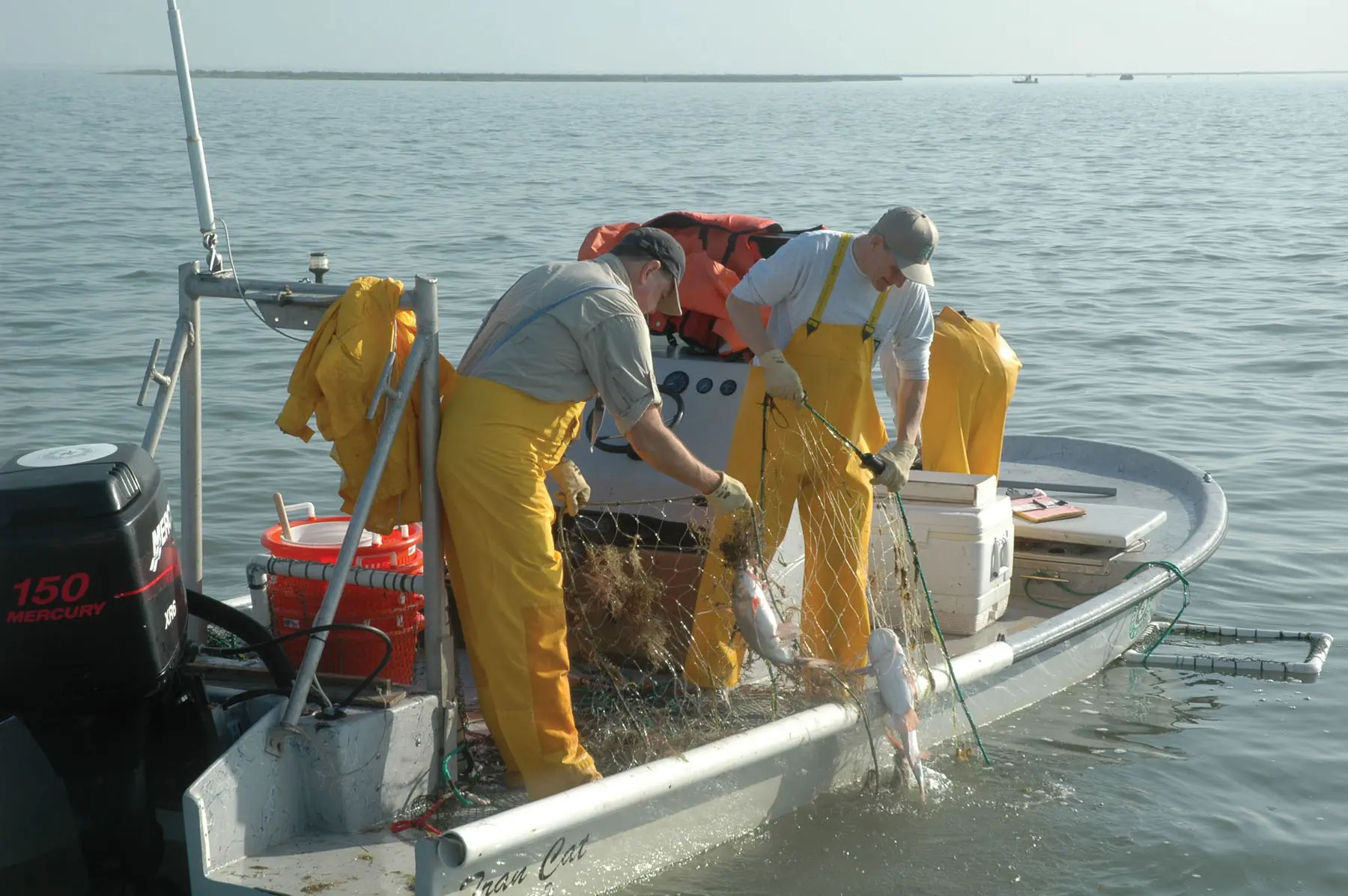
The Texas Parks and Wildlife Department’s gill net sampling program continues to remain suspended due to a federal investigation. The impacts of this threaten to dismantle the longest running fishery independent monitoring program of its kind in the country. An interruption in the program could lead to a lack of sufficient and current data necessary to monitor the status of the state’s coastal fisheries.
According to Deputy Director of the TPWD Coastal Fisheries Division Dakus Geeslin, all TPWD gill net monitoring and survey efforts ceased on May 23, 2024. This was in response to a formal notice from NOAA Fisheries’ Office of Law Enforcement and Office of Protected Resources that a formal investigation into TPWD was being launched over alleged violations of the Marine Mammal Protection Act and the Endangered Species Act.
The alleged violations arose from incidental and rare encounters with bottlenose dolphins and sea turtles that have taken place throughout TPWD’s gill net sampling efforts over more than 4 decades. In an act to work in good faith with NOAA, TPWD has reported these encounters as they have occurred over the years, as a part of its normal operating processes for the gill net sampling program.
“Since 1983, TPWD has recorded 41 dolphin encounters,” Geeslin said. “That’s an average of about one per year, across over more than 30,000 gill net sets. Not to mention, the majority of these dolphins were released alive.”
Geeslin said TPWD has recorded approximately 300 sea turtle encounters throughout their gill net sampling efforts since 1983, with less than half of those resulting in mortalities. He also confirmed that during the more than 40-year stretch, TPWD participated in the rescuing, rehabilitation, and reintroduction of thousands of sea turtles along the Texas coast.
“We have asked NOAA many times since we received their notice of investigation back in May of 2024, what the status of their investigation is,” Geeslin said. “We have also asked them exactly who or what within TPWD is under investigation. They have refused to provide us with any specific details or answers to either of those questions.”
According to the Chief of Science and Policy Resources branch for the TPWD Coastal Fisheries Division Tiffany Hopper, TPWD has applied for incidental take authorization permits for dolphins and sea turtles multiple times over the last decade. The most recent application was submitted earlier this year; however, NOAA has yet to issue these permits.
“The permits remain in process with NOAA, as they continue to make additional requests for information and details from the department,” Hopper said. “TPWD is continuing to attempt to work in good faith with NOAA to answer their requests in hopes to obtain these permits.”
Hopper said NOAA has granted similar incidental take authorization permits to a variety of other entities, including private companies and organizations for activities involving marine mammals and endangered species. Some of these entities have publicly documented higher rates of encounters with marine mammals and endangered species than TPWD.
This inconsistency raises concern and is highly suggestive that NOAA could be selectively applying its regulatory authority in a way that undermines TPWD’s goals and mission. Geeslin said it leaves TPWD caught in between its legal obligations and its scientific mission of managing and improving our coastal fisheries.
“It appears NOAA is attempting to further delay the review and the issuing of these permits,” Geeslin said. “Despite our efforts to work in good faith with NOAA, they continue to draw out the process.”
Geeslin encourages anyone who is concerned about the status of this issue and the future of our state’s gill net sampling program to reach out to their elected congressmen and senators.
CCA Texas Advocacy Director Shane Bonnot said it’s important for folks to realize dolphin populations have increased by as much as 2,700% in parts of the Texas coast since the early 1990s. This only reinforces that the impact of TPWD’s gill net program is negligible.
“Dolphin interactions are becoming a major problem for our fisheries, especially when folks are trying to safely release fish while practicing catch and release,” Bonnot said. “Dolphins are very comfortable around fishing activity and boats and seem to be relying more and more on angler presence for locating their food supply. Gill nets are not the issue. The issue is we have a lot more dolphins than we’ve ever seen, and they are more comfortable around us than they’ve ever been.”
Bonnot said without gill net sampling, Texas is forfeiting a vital tool for the management of its coastal fisheries.
“We just can’t make accurate decisions without the data the gill net sampling program provided us with,” Bonnot said.
Multiple attempts to reach NOAA went unanswered.
