


It’s a traveling hunter’s worst nightmare.
Arrive at the airport gate in a foreign country, and not only is the outfitter not there to meet you, they have no idea the hunter is even coming to hunt. Sound crazy? It could be a reality due to a new scam targeting hunters – cloned or outright fake outfitter websites fooling hunters to send deposits for non-existent hunts.
It’s happened to at least two outfitters in British Columbia, according to Scott Ellis, CEO of Guides Outfitters Association of British Columbia (GOABC). The prospective hunters and outfitters – who did not wish to be named – found out about it by chance before the hunter arrived.
“Basically, a hunter phoned a BC outfitter and said his wire transfer did not go through,” Ellis said. “He asked the outfitter to please confirm the account number. By fluke, he phoned the number he had previously for the outfitter, not the number listed on the website. The outfitter told him he was fully booked until 2027, didn’t have a spot for him and had no clue what the hunter was talking about.”
The outfitter in this instance did not even have a website, so the entire site was a fake.
“The guide told the hunter my business is all repeat clients, and I don’t have a website and don’t plan on getting one,” Ellis said. “The imposter had emailed, had a local phone number and looked very legit.”
Despite the apparent fraud, Canadian police did not follow up on the case because they said no money actually changed hands, so a crime wasn’t committed. A cloned Facebook page for the outfitter was removed by Meta, but the website remains up and active. Ellis said the outfitter is working on obtaining an injunction to have the site taken down, but if the server and culprits are in a foreign country, the injunction probably won’t matter or be effective.
Ellis said outfitters have been purchasing Internet domain names matching their business, even if they have no intention of making them active.
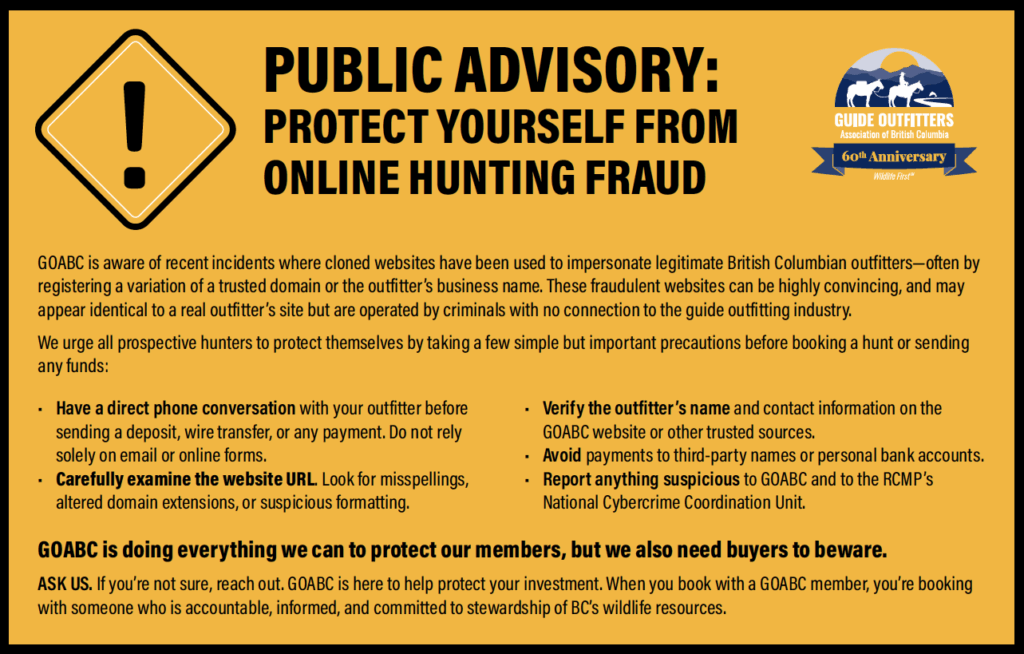
“Hunters, please don’t send a wire transfer until you speak to the outfitter directly,” Ellis added. “Call us (GOABC)! We can verify things for visiting hunters. We want folks to be aware this is happening. Once you hit send on a wire transfer, that money is gone. We don’t want anyone showing up at the airport and nobody is there to pick them up because nobody knew they were coming.”
Several hunting organizations have posted warnings in the past few weeks.
SCI’s CIO Paul Guagliardo said, “Unfortunately, with advancements in AI and website cloning, it’s getting harder to tell the difference between legitimate outfitters and spoofed sites. While there is no foolproof way to spot these bad actors, both hunters and outfitters can take certain steps when conducting business online to protect themselves. The most important thing is to practice vigilance, which requires close attention to details.”
Other steps hunters can take, according to SCI.
- Beware of Suspicious Website URLs with slight misspellings, extra characters, unusual endings (e.g., .net, .xyz, .info instead of .com)
- Google Search the Outfitter instead of clicking on links or advertising on social media and other digital platforms
- Look for the HTTPS (Secure Connection) If the website address doesn’t start with https:// or is missing the padlock icon 🔒, it’s a red flag
- Verify Contact Information If there’s no phone number, no business address, or a generic email (like Gmail or Yahoo), that’s a warning sign
- Beware of Stock Photos or Stolen Images Use Google Image Search to check if the photos on their website are used elsewhere
- Scrutinize the Site Look for poor design, copy-paste content, sloppy layout, low-quality images, generic text, inconsistent branding, conflicting or incompatible content
Conduct Due Diligence
- Call and Speak with the Outfitter Don’t rely on just email or text
- Look for an Online Presence or Reviews A reputable outfitter should have Google reviews, social media activity, or be listed with hunting associations or directories
- Look for License or Accreditation Info Look for a guiding license number and professional affiliations, then verify them
