

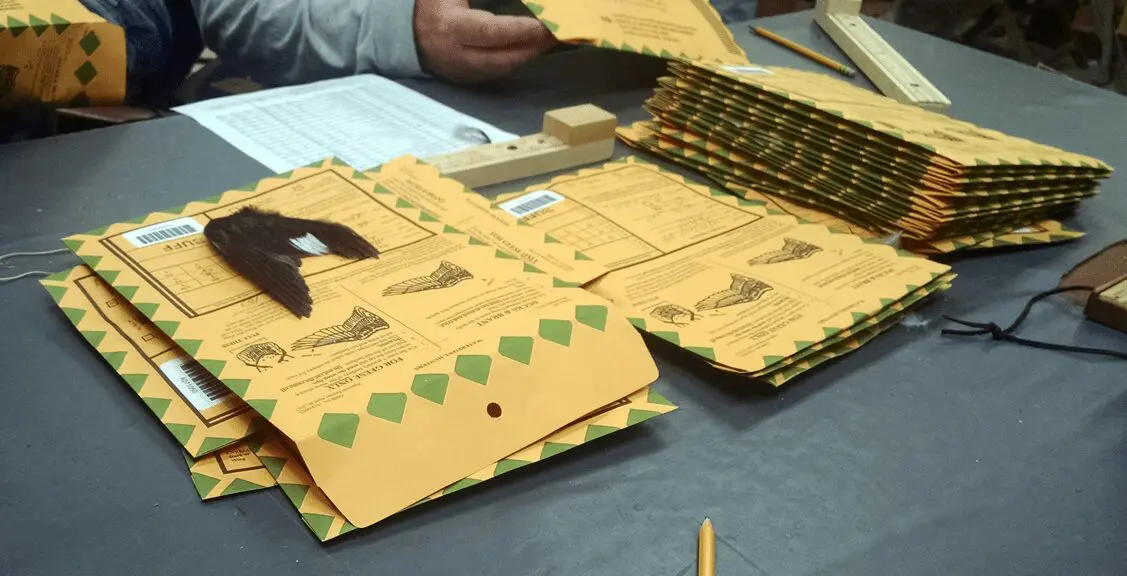
The avid duck hunter walked back from the mailbox with a group of giant envelopes, wondering what they were. For others, it might be the second or third time they have been asked to provide wings from all of the ducks they shoot over the season.
On the envelope states, Waterfowl Parts Collection Survey, with some basic instructions.
Some are happy to participate, while others put the envelopes aside.
What happens after the wings are sent back to the U.S. Fish and Wildlife Service?
According to Paul Padding, an Atlantic Flyway biologist, 6,000-8,000 hunters nationwide are asked to send in their wings.
Nationwide, they receive about 90,000 duck wings and 20,000 goose tails and wing tips. During the season, as the wings come in, specific persons in each flyway identify the species and then store the wings in a freezer for an end-of-season party, of sorts.
The get-together is called the Wingbee, the name is a take-off on the quilting bees your grandmother may have participated
in. In late January or February of each year, 40 to 50 people, including biologists and technicians from the Service and from state agencies, spend a week processing all of the wings.
What do they learn?
The Service said the information helps set harvest estimates and helps evaluate hunting seasons, but how?
The answer isn’t really that complicated. The first focus is on age and sex information, where biologists learn whether most of the ducks taken were young of the year or adult birds.
“It gives an index of productivity on the breeding grounds,” Padding said.
For example, in a year when waterfowl production is high, there will be more young birds than adults in hunters’ bags. In a year when production is low, hunters shoot more adult birds.
Calculating the approximate harvest from each species is another piece to the puzzle. Data from the surveys are important for modeling populations and helping wildlife managers set and evaluate hunting seasons, the Service said.
“Data from the Wingbees help us estimate the number of birds of different species, sex, and age in the year’s harvest,” Padding said. “They also inform us about how the harvest is changing over time and among different locations
Combined with harvest estimates from the Waterfowl Hunter Survey, the number of wings from each species are used to
calculate the approximate harvest from each species.
For example, if the estimated harvest for the Pacific Flyway was 2 million ducks and 10 percent of the wing sample was pintails, then the Pacific Flyway’s estimated pintail harvest would be 200,000.
Padding said the information reliability is the result of decades (more than 40 year) of study.
“More recently, we input age ratios into Adaptive Harvest Management models to help set and evaluate hunting seasons,” Padding said.
The next time those big envelopes show up at your door, it might be worth it to send in those wings.
