

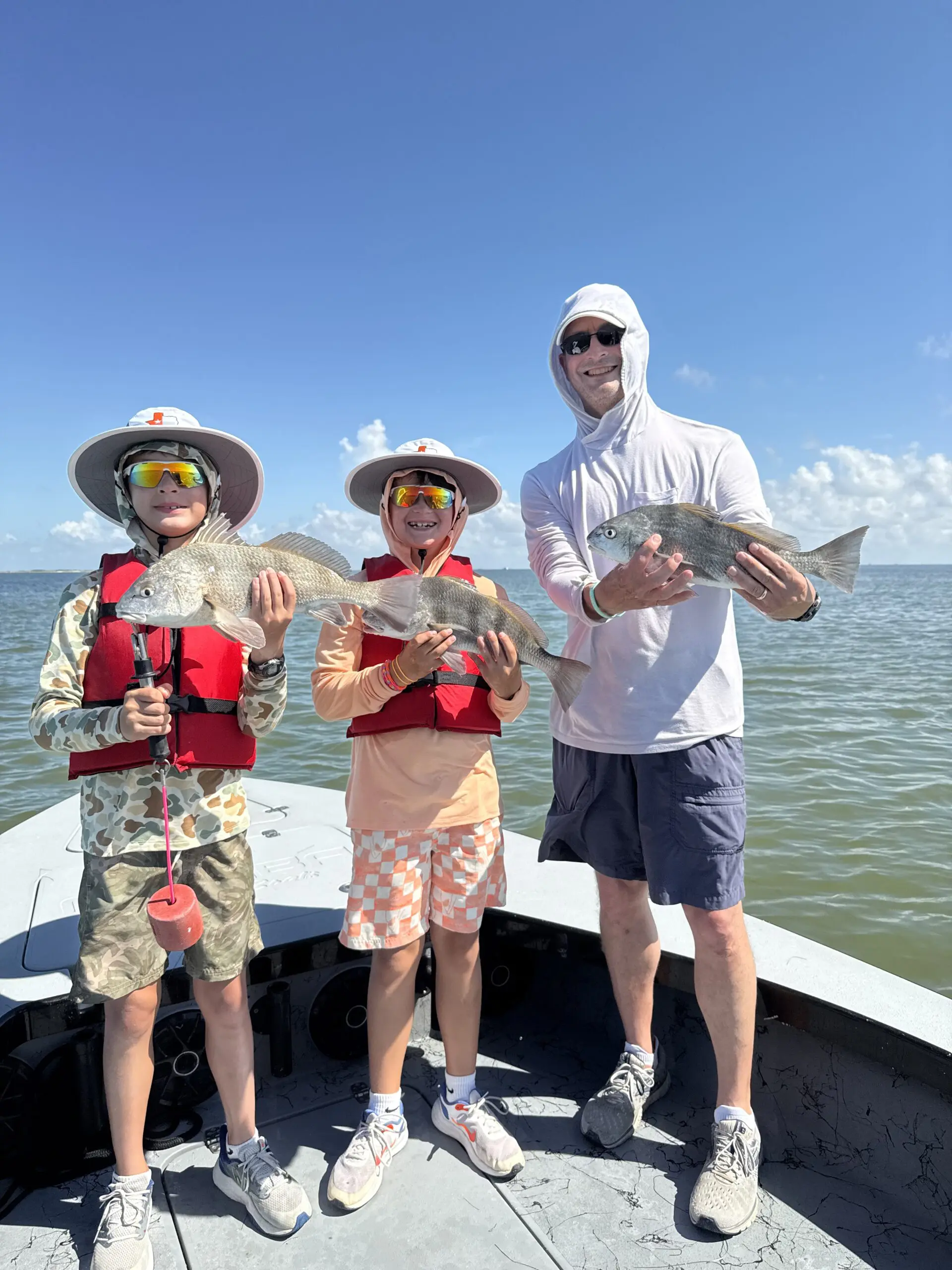
Anglers have been taking advantage of consistent schooling action from black drum across flats along the waters of the Coastal Bend.
Some drum are schooling over deeper grass beds in 3-4 feet of water, while others have been found along shallower flats littered with both seagrass and sand pockets. Fresh dead shrimp has been the bait of choice for those sight casting to the schools of fish.
Capt. Ryan Sinclair has been pursuing black drum with his anglers along the upper Laguna Madre out North Padre Island, where he said the fish have been congregating in large schools from mid-morning to to the midday hours.
“There are several big schools roaming over grass beds in about 3 feet of water,” Sinclair said. “We are sight-casting to them with a chunk of fresh dead shrimp. The key has been waiting until you see the school of fish to cast. If you try blind casting, you’re most likely going to have your bait stolen by perch.”
The schools of drum have been holding in specific areas, day in and day out, so he has been able to consistently stay on them. Most of the fish have been anywhere from 18-24 inches in length.
“The schools have been fairly cooperative and have been relatively easy to stay within casting distance once we locate them,” Sinclair said. “Chasing these schools has been producing a bunch of multiple hook-ups with our anglers. It’s really been a lot of fun.”
Corpus Christi Capt. Tim Meyer said the black drum bite has been on fire.
“The best schooling action for drum has been taking place after the sun gets higher in the sky during the late morning hours,” Meyer said. “It’s a lot easier to see the fish after the sun comes up, and that makes it easier for folks to make accurate casts to them.”
Most of the schools have been holding in 3-4 feet of water over flats with grass beds and sandy potholes.
“The fish are eating small crustaceans and crabs that are hiding in the grass between the sand pockets,” Meyer said. “We have been catching them on fresh dead shrimp rigged on jig heads.”
Meyer varies the size of the jig head depending on the wind and whether the fish are holding tight to the bottom or along the top half of the water column. Most of the black drum have been from 16-22 inches.
Capt. Jesse Torres has been chasing schools of black drum in Baffin Bay in about 1.5-2 feet of water along the edges of grass beds where the seagrass transitions to a sandy bottom.
“The fish are grubbing along the bottom and feeding on small crabs and crustaceans near the edges of the grass,” Torres said. “Because these schools are pretty shallow, you have to be mindful how you approach them, otherwise they will spook off to deeper water in a hurry. They can be pretty hard to target if you can’t see them.”
Torres said mid-morning has been the best time to catch them.
“As the sun rises and the water heats up, the fish start to pile up along the edges of the grass,” he said.
Torres has breaking the head off fresh dead shrimp and then threading the shrimp onto a bare hook or the hook of a light jig head.
“The best approach has been to cast the bait past the school or ahead of them in the direction they are moving, and then bring the bait back to them, right in front of their noses,” he said. “If you cast right in the middle of the school, you’re more than likely going to spook them.”
