

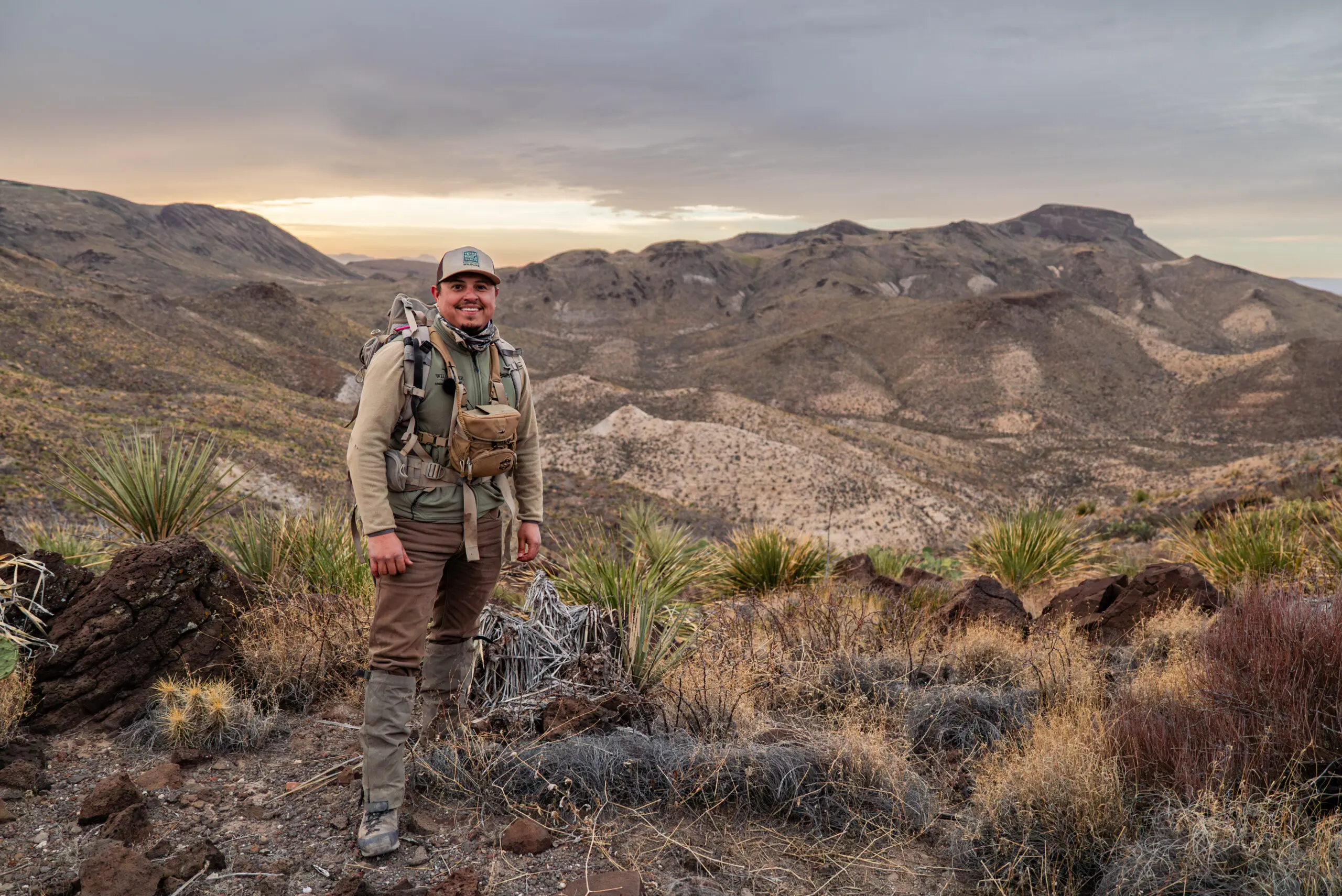
Getting a hold of Texas Parks and Wildlife Department’s new Bighorn Sheep Program Leader Jose Etchart can be a challenge these days.
When he’s not trying to keep Texas desert bighorn sheep safe and on the mountain from a number of things trying to knock the population down, he’s often guiding hunters on Big Time Texas hunts or the lucky winners who drew a sheep hunting permit this past season.
“We just finished up our hunt for the Big Time Texas hunt winner,” Etchart said. “I was guiding and the hunt took place at Black Gap WMA, for the first time in 11 years. Usually, we host these hunts at Elephant Mountain (WMA).”
Etchart was born and raised in El Paso, where he split time between there and his family’s ranch in Chihuahua Mexico. After high school, he attended Sul Ross State University in the Animal Science department. Persistence is one of his best traits, and Etchart employed that persistence by bugging the secretary daily to find a job.
“I literally bugged her daily until she asked if I wanted to be her assistant?” Etchart said. “It was great, because I got to meet all of the professors in the department by delivering their mail. I met Dr. Louis Harveson and I had just gone along on a scaled quail project on 9 Point Mesa. He said the group had liked me and he asked if I’d be interested in becoming a wildlife technician? By my second term, they hired another grad student to track sheepo from Elephant Mountain to Nine Point. I really got into tracking sheep. I knew it was something special.”
Etchart immediately began volunteering with the sheep program, and in 2011, TPWD hired Etchart for a seasonal positing for 8 months.
“I loved it,” he said. “I applied for another wildlife technician job through the wildlife technician program, and in 2016, a wildlife biologist position opened up in Van Horn County. It involved a lot of sheep stuff, so I was excited to get that job. I’ve been going up the ladder ever since.”
After becoming a member of the state’s Bighorn Sheep Committee, Etchart moved back to El Paso in 2019 and got to participate in moving the first group of bighorns back into the Franklin Mountains. In December, 77 desert bighorn sheep were released into Franklin Mountains State park, icluding 40 ewes and 37 rams, all translocated from Elephant Mountain.
“I loved working there and thought maybe one day I can retire as the Bighorn Sheep Program Leader,” Etchart said. “I was maybe hoping one day, but it seemed to happen faster than I thought it would.”
Etchart took over from former Leader Froylan Hernandez. He said several issues are facing Texas’ bighorn sheep that could impact their population numbers moving forward. Currently, the Texas bighorn population has decreased by 50% due to disease and competition from another sheep species, the aoudad. Etchart wrote his Masters thesis on the relationship between bighorns and aoudad, which are much more disease-resistant and a hardier animal overall than a bighorn sheep.
“The Mycoplasma ovipneumoniae, or Movi, is on the landscape. It’s a bacteria that turns into pneumonia in sheep,” Etchart said. “That is currently the biggest threat we face with bighorn sheep. The second biggest threat is the aoudad population. They compete for resources with bighorns and they carry the Movi disease and are potential transmitters for the disease.”
Etchart said a philosophical shift has occurred recently within the department, from a purely restoration mindset to now holding off on translocation projects while keeping the sheep currently on the landscape alive and healthy.
“We don’t really know exactly what triggers the Movi disease,” he said. “We think it comes from domestic sheep and goats, but did the sheep get it first? Did the aoudad get it first? Did it come strictly from feral goats or sheep? We know it is really detrimental to bighorn sheep but aoudad can deal with it and it won’t kill them.”
Etchart said bighorn sheep are a cornerstone species of southwest Texas, but they are a fragile species in some regards.
“These sheep live in tough environments often times at high elevation,” he said. “They are tough species but they are fragile. If something doesn’t go right, it’s hard on them. They also only have one lamb each year, so they don’t reproduce like other species.”
Etchart said hunting opportunities for Texas bighorns remain rare, with a few lucky hutners drawing a public permit through TPWD’s hunt system, or purchasing a tag, often close to $100,000, through conservation organizations’ auctions on private land.
“Some ranches are still getting permits after we complete our population checks,” Etchart said. “There are a couple of permits around, but very few.”
Etchart said the help TPWD receives from private stakeholders and groups such as the Texas Bighorn Society, Wild Sheep Foundation, DSC and SCI, is vitally important for the future of the species.
“Those groups are very important,” he said. “We need all hands on deck. This is the lowest population of sheep we’ve had in some time, but we aren’t starting at zero. In the 1960s, we started at zero.”
On the few days he’s not working, Etchart said he loves hunting mule deer, elk and now, sheep.
“I’m a big mountain guy,” he said. “I’m a big hunter but spend more time on the guide side of it. I do love chasing mule deer. I’m just so passionate about sheep hunting, even though I have yet to be the one to pull the trigger. I got to call the shot on the last sheep hunt, and it was really special.”
